In clinical terminology, “heart pain” typically refers to angina pectoris or acute myocardial ischemia—a condition where the heart muscle (myocardium) does not receive a sufficient supply of oxygen-rich blood due to narrowed or blocked coronary arteries. Heart pain can present across a clinical spectrum: from stable angina, which occurs predictably during physical exertion or emotional stress and subsides with rest, to unstable angina or an acute myocardial infarction (heart attack), which occurs suddenly at rest and constitutes a life-threatening medical emergency. Additionally, conditions such as pericarditis (inflammation of the heart sac) or structural valve disorders (like aortic stenosis) can also trigger cardiac discomfort.
In Patna and across Bihar, a rising prevalence of metabolic risk factors—including unmanaged hypertension, Type 2 diabetes, and dyslipidemia—has contributed to an increased incidence of ischemic heart pain. Effectively treating heart pain requires rapid diagnostic differentiation, immediate emergency stabilization for acute events, and structured revascularization or medical therapy.
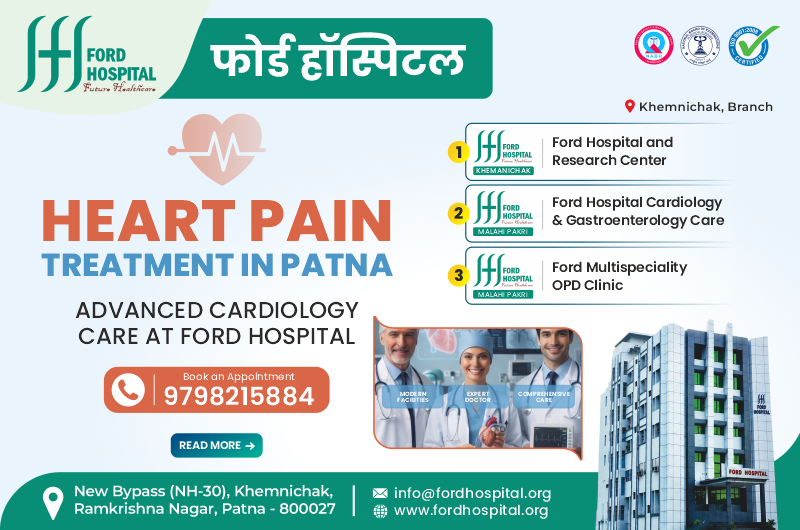
For patients requiring prompt evaluation and treatment for heart pain, the Ford Hospital network provides a comprehensive clinical ecosystem. In strict adherence to the National Medical Commission (NMC) 2026 guidelines regarding factual, transparent, and evidence-based medical communication, the following is an objective overview of our network’s healthcare facilities designed to evaluate and treat cardiac pain. The facilities are structured sequentially by their role in acute emergency and surgical intervention, targeted catheter-based diagnostics, and long-term outpatient care.
Effectively managing heart pain requires a protocol-driven clinical continuum: immediate triage and surgical backup for severe or unstable ischemia, targeted interventional procedures to open narrowed arteries, and structured outpatient monitoring for chronic stable angina.
Functioning as the primary multispeciality inpatient, surgical, and emergency center of the network, Ford Hospital & Research Center (located near New Bypass, Khemnichak, Patna) serves as the primary hub for managing acute, severe, or unstable heart pain.
When a patient presents with unyielding cardiac pain, the immediate clinical priority is to prevent irreversible heart muscle damage and manage potential hemodynamic instability.
Multidisciplinary Clinical Directory at Ford Hospital:
Operating as a focused dual-specialty facility, Ford Hospital Cardiology & Gastroenterology Care (located at Malahi Pakri, Kankarbagh, Patna) is structured to manage targeted interventional procedures for ischemic heart pain and resolve complex diagnostic overlaps.
Explore Our Dedicated Core Services:
For patients experiencing predictable, exertional heart pain (stable angina) or those requiring ongoing secondary prevention after a cardiac procedure, the Ford Multispeciality OPD Clinic serves as the primary access point for non-invasive diagnostics and medical titration.
Outpatient Specialty Directory:
The clinical evaluation and treatment of heart pain require diagnostic precision and procedural competence. In compliance with NMC guidelines prohibiting superlative rankings of medical practitioners, Ford Hospital provides a team of experienced clinicians across interventional cardiology, non-invasive diagnostics, and cardiothoracic surgery:
Understanding the nature of cardiac pain helps determine the urgency of medical care. While all new-onset heart pain requires clinical evaluation, patients should recognize the distinction between stable and emergency presentations:
Cardiologists follow standardized, evidence-based protocols to relieve cardiac pain and prevent future myocardial infarctions:
1. What is the difference between heart pain (angina) and a heart attack?
Angina is temporary cardiac pain caused by reduced blood flow to the heart muscle during exertion; it does not cause permanent tissue damage and typically resolves with rest. A heart attack (myocardial infarction) occurs when a coronary artery becomes completely or severely blocked, causing prolonged oxygen deprivation and permanent damage to the heart muscle if not treated immediately.
2. How long does typical angina pain last?
Episodes of stable angina generally last between 2 and 10 minutes and subside within 5 minutes of resting or taking prescribed sublingual nitrate medication. If chest pain persists beyond 10 to 15 minutes at rest, it must be treated as a medical emergency.
3. Can a normal resting ECG rule out heart pain caused by blocked arteries?
No. In patients with chronic stable angina, a resting 12-lead ECG is frequently normal between pain episodes. Evaluating exercise-induced ischemia often requires functional testing (like a Treadmill Stress Test) or anatomical imaging (such as a CT Coronary Angiogram or invasive catheter angiography).
4. When is stenting (angioplasty) vs. bypass surgery (CABG) chosen for heart pain?
The choice depends on the location, number, and complexity of the arterial blockages. Angioplasty and stenting (PCI) are commonly used for single- or double-vessel blockages, whereas CABG surgery is frequently recommended for complex triple-vessel disease or significant left main coronary artery stenosis, particularly in diabetic patients.
5. Is cashless hospitalization available for emergency heart pain treatment?
Ford Hospital operates a dedicated Third-Party Administrator (TPA) and Insurance coordination desk that facilitates cashless admissions for cardiac emergencies, angiographies, and surgical procedures under recognized private insurers and eligible government healthcare schemes, subject to standard policy terms.