
Emergency : +91 9798215884   |   Front Desk : +91 93863 92846   |   Address : New Bypass (NH-30), Khemnichak, Patna - 800027 (Bihar)

Heart Pain Treatment in Patna

Heart Pain Treatment in Patna

Heart Pain Treatment in Patna: A Clinical Guide to Angina and Ischemic Cardiac Care

In clinical terminology, “heart pain” typically refers to angina pectoris or acute myocardial ischemia—a condition where the heart muscle (myocardium) does not receive a sufficient supply of oxygen-rich blood due to narrowed or blocked coronary arteries. Heart pain can present across a clinical spectrum: from stable angina, which occurs predictably during physical exertion or emotional stress and subsides with rest, to unstable angina or an acute myocardial infarction (heart attack), which occurs suddenly at rest and constitutes a life-threatening medical emergency. Additionally, conditions such as pericarditis (inflammation of the heart sac) or structural valve disorders (like aortic stenosis) can also trigger cardiac discomfort.

In Patna and across Bihar, a rising prevalence of metabolic risk factors—including unmanaged hypertension, Type 2 diabetes, and dyslipidemia—has contributed to an increased incidence of ischemic heart pain. Effectively treating heart pain requires rapid diagnostic differentiation, immediate emergency stabilization for acute events, and structured revascularization or medical therapy.

For patients requiring prompt evaluation and treatment for heart pain, the Ford Hospital network provides a comprehensive clinical ecosystem. In strict adherence to the National Medical Commission (NMC) 2026 guidelines regarding factual, transparent, and evidence-based medical communication, the following is an objective overview of our network’s healthcare facilities designed to evaluate and treat cardiac pain. The facilities are structured sequentially by their role in acute emergency and surgical intervention, targeted catheter-based diagnostics, and long-term outpatient care.

Integrated Cardiovascular Facilities Across the Network

Effectively managing heart pain requires a protocol-driven clinical continuum: immediate triage and surgical backup for severe or unstable ischemia, targeted interventional procedures to open narrowed arteries, and structured outpatient monitoring for chronic stable angina.

1. Ford Hospital And Research Center — Comprehensive Tertiary Healthcare Hub

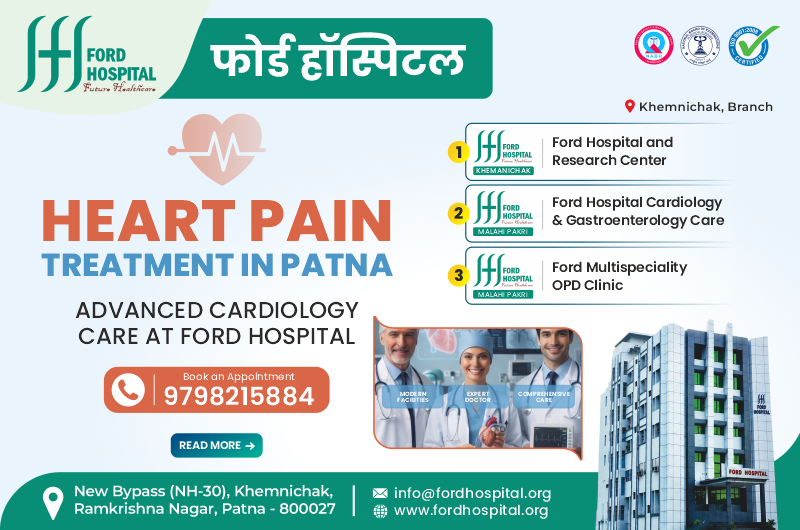
Functioning as the primary multispeciality inpatient, surgical, and emergency center of the network, Ford Hospital & Research Center (located near New Bypass, Khemnichak, Patna) serves as the primary hub for managing acute, severe, or unstable heart pain.

When a patient presents with unyielding cardiac pain, the immediate clinical priority is to prevent irreversible heart muscle damage and manage potential hemodynamic instability.

  • 24/7 Emergency Triage & Acute Care: The facility features a dedicated emergency response team available around the clock. Patients presenting with acute heart pain undergo immediate 12-lead ECG evaluations and High-Sensitivity Troponin biomarker testing to confirm or rule out an evolving myocardial infarction.
  • Emergency Revascularization & Cardiac Surgery: If acute heart pain is caused by a sudden arterial occlusion, the on-site Catheterization Laboratory (Cath Lab) is activated for emergency primary angioplasty. For patients whose heart pain is driven by complex triple-vessel disease or left main stem blockages unsuitable for stenting, the hospital maintains dedicated surgical suites for Coronary Artery Bypass Grafting (CABG).
  • Intensive Coronary Care (ICCU) & Multisystem Support: Patients recovering from severe ischemic episodes or cardiogenic shock are managed in specialized ICCUs equipped for continuous hemodynamic monitoring, mechanical ventilation, and multidisciplinary support across nephrology and pulmonology.

Multidisciplinary Clinical Directory at Ford Hospital:

  • 24×7 Emergency & Trauma Care — The absolute frontline for acute myocardial infarctions (heart attacks), sudden cardiac arrest, and complex cardiogenic shock requiring immediate hemodynamic stabilization.
  • Cardiology & Angioplasty Centre — The core surgical hub for clearing blocked arteries via primary emergency stenting and managing severe, life-threatening heart rhythm disorders.
  • Cardiac Surgery (CABG, Valve) — Providing highly advanced “beating heart” bypass surgeries, complex heart valve replacements, and surgical repairs for structural heart defects.
  • Neurology & Neurosurgery – including Brain-Stroke Unit — Crucial for managing the severe stroke risks associated with Atrial Fibrillation (irregular heartbeat) and sudden drops in blood pressure to the brain during cardiac events.
  • Gastroenterology & Hepatology — Treating severe gastric overlaps (like extreme acid reflux) that often mimic the chest pain of heart attacks, preventing fatal misdiagnoses, and managing liver congestion caused by right-sided heart failure.
  • Urology & Kidney-Stone Clinic — Managing structural urinary issues, particularly for elderly male cardiac patients who cannot safely stop their life-saving blood-thinning medications for standard surgeries.
  • Nephrology & Dialysis Centre — Protecting the kidneys from “Cardio-Renal Syndrome,” a deadly condition where severe heart failure directly causes the kidneys to shut down, requiring immediate dialysis.
  • Critical Care & ICU — Fully equipped with advanced ventilators, continuous hemodynamic monitoring, and Intra-Aortic Balloon Pumps (IABP) to mechanically keep the heart pumping in highly unstable patients.
  • Internal Medicine — Managing complex, multi-system infections that can directly attack and destroy the heart valves, a dangerous condition known as infective endocarditis.
  • Endocrinology & Diabetes — Diabetes is the ultimate catalyst for cardiovascular destruction. Our endocrinologists strictly manage HbA1c levels to protect the coronary arteries from further plaque buildup.
  • General & Laparoscopic Surgery — Providing comprehensive surgical backup if cardiac patients suffer from overlapping physical traumas or acute abdominal emergencies.
  • Orthopedics & Trauma – Knee Replacement — Restoring pain-free joint mobility so recovering cardiac patients can safely engage in the cardiovascular treadmill exercise absolutely required for heart rehabilitation.
  • Physiotherapy & Rehabilitation — Delivering specialized, heavily monitored Cardiac Rehab programs to help heart attack survivors safely rebuild their cardiovascular endurance and heart muscle strength.
  • Pulmonology & Respiratory Care — Treating severe pulmonary edema (fluid violently backing up into the lungs) caused by left-sided congestive heart failure.
  • ENT (Ear-Nose-Throat) — Managing severe Obstructive Sleep Apnea, which is a major, hidden trigger for highly dangerous nighttime cardiac arrhythmias and sudden high blood pressure spikes.
  • Dietetics & Nutrition — Providing highly customized, strict meal plans designed specifically to manage sodium intake, drastically lower LDL cholesterol, and reduce overall body weight for optimal cardiac recovery.
  • Plastic & Reconstructive Surgery — Assisting in complex wound management and sternal closure reconstruction following major open-heart bypass surgeries to prevent deep chest infections.
  • Obstetrics & Gynaecology – Maternity / Pregnancy Care, Women’s Health — Managing high-risk pregnancies that are complicated by maternal congenital heart defects, arrhythmias, or severe, heart-straining preeclampsia.
  • Pediatrics & Child Hospital — Treating congenital heart disease, murmurs, and structural cardiac defects in infants, toddlers, and young children.
  • Piles & Proctology Clinic — Providing minimally invasive laser treatments for severe hemorrhoids in cardiac patients who are on strict, lifelong blood-thinner protocols and cannot risk traditional surgery.

2. Ford Hospital Cardiology & Gastroenterology Care

Operating as a focused dual-specialty facility, Ford Hospital Cardiology & Gastroenterology Care (located at Malahi Pakri, Kankarbagh, Patna) is structured to manage targeted interventional procedures for ischemic heart pain and resolve complex diagnostic overlaps.

  • Interventional Diagnostics & Angioplasty: For patients experiencing recurrent angina, this facility conducts diagnostic transradial coronary angiographies to anatomically map arterial blockages. Specialists utilize intravascular imaging modalities (such as IVUS and OCT) and Fractional Flow Reserve (FFR) to assess the physiological significance of narrowings and perform precise Percutaneous Coronary Interventions (PCI / stenting).
  • Cardio-Gastric Differential Diagnosis: Severe esophageal spasms, peptic ulcer disease, and Gastroesophageal Reflux Disease (GERD) frequently produce retrosternal burning or squeezing sensations that closely mimic angina. Direct clinical collaboration between cardiologists and gastroenterologists allows for a coordinated diagnostic pathway to accurately localize and treat the source of the pain.
  • Arrhythmia & Hemodynamic Monitoring: The center provides specialized observation and electrophysiological evaluations when cardiac discomfort is accompanied by abnormal heart rhythms or palpitations.

Explore Our Dedicated Core Services:

3. Ford Multispeciality OPD Clinic (The Frontline of Heart Health)

For patients experiencing predictable, exertional heart pain (stable angina) or those requiring ongoing secondary prevention after a cardiac procedure, the Ford Multispeciality OPD Clinic serves as the primary access point for non-invasive diagnostics and medical titration.

  • Non-Invasive Ischemia Evaluation: The clinic offers structured outpatient assessments, including resting 12-lead ECGs, 2D Echocardiography to evaluate ventricular function and valve health, and Treadmill Stress Testing (TMT) to observe how the heart muscle responds to controlled physical exertion.
  • Anti-Anginal Medication Titration: Clinical guidelines recommend targeted pharmacological therapy as the first-line approach for stable angina. Cardiologists provide dedicated consultations to prescribe and adjust beta-blockers, calcium channel blockers, long-acting nitrates, antiplatelets, and high-intensity statins.
  • Secondary Prevention & Rehabilitation: The clinic coordinates long-term follow-up care, including blood pressure optimization, glycemic control, and structured dietary counseling to halt the progression of coronary atherosclerosis.

Outpatient Specialty Directory:

The Cardiovascular Medical Team

The clinical evaluation and treatment of heart pain require diagnostic precision and procedural competence. In compliance with NMC guidelines prohibiting superlative rankings of medical practitioners, Ford Hospital provides a team of experienced clinicians across interventional cardiology, non-invasive diagnostics, and cardiothoracic surgery:

Recognizing the Warning Signs: Stable vs. Unstable Heart Pain

Understanding the nature of cardiac pain helps determine the urgency of medical care. While all new-onset heart pain requires clinical evaluation, patients should recognize the distinction between stable and emergency presentations:

  • Stable Angina (Requires Prompt Outpatient Evaluation): A dull ache, heaviness, or tightness in the center of the chest triggered predictably by physical exertion, climbing stairs, or emotional stress. It typically lasts between 2 to 10 minutes and resolves promptly with rest or prescribed sublingual nitrate medication.
  • Unstable Angina / Heart Attack (Requires Immediate Emergency Care): Severe crushing pressure, squeezing, or fullness in the chest that occurs at rest, wakes you from sleep, or increases rapidly in frequency and intensity.
  • Radiating Discomfort: Pain that spreads from the chest to the left shoulder, down the inner aspect of the left arm, or into the neck, jaw, and upper back.
  • Autonomic & Associated Symptoms: Heart pain accompanied by acute shortness of breath (dyspnea), cold sweats (diaphoresis), unexplained dizziness, lightheadedness, or nausea requires immediate transport to a 24/7 emergency facility.

Evidence-Based Clinical Management of Heart Pain

Cardiologists follow standardized, evidence-based protocols to relieve cardiac pain and prevent future myocardial infarctions:

  1. Acute Symptom Relief: Patients diagnosed with stable angina are often prescribed short-acting sublingual nitrates to rapidly dilate coronary vessels during an acute episode or prophylactically before planned exertion.
  2. Foundational Anti-Ischemic Therapy: Daily medications such as beta-blockers or calcium channel blockers are utilized to reduce the heart rate and blood pressure, thereby lowering the heart muscle’s oxygen demand.
  3. Plaque Stabilization: Lifelong antiplatelet therapy (such as low-dose aspirin) and high-intensity statins are prescribed to prevent blood clots and stabilize cholesterol plaques within the coronary arteries.
  4. Coronary Revascularization: When medical therapy alone does not adequately control heart pain, or when diagnostic angiography reveals high-risk arterial narrowing, blood flow is mechanically restored via Percutaneous Coronary Intervention (PCI / stenting) or CABG surgery.
  5. Risk Factor Modification: Strict cessation of tobacco use, control of HbA1c and blood pressure levels, and adherence to a low-sodium, heart-healthy diet are essential to prevent disease progression.

Frequently Asked Questions

1. What is the difference between heart pain (angina) and a heart attack?

Angina is temporary cardiac pain caused by reduced blood flow to the heart muscle during exertion; it does not cause permanent tissue damage and typically resolves with rest. A heart attack (myocardial infarction) occurs when a coronary artery becomes completely or severely blocked, causing prolonged oxygen deprivation and permanent damage to the heart muscle if not treated immediately.

2. How long does typical angina pain last?

Episodes of stable angina generally last between 2 and 10 minutes and subside within 5 minutes of resting or taking prescribed sublingual nitrate medication. If chest pain persists beyond 10 to 15 minutes at rest, it must be treated as a medical emergency.

3. Can a normal resting ECG rule out heart pain caused by blocked arteries?

No. In patients with chronic stable angina, a resting 12-lead ECG is frequently normal between pain episodes. Evaluating exercise-induced ischemia often requires functional testing (like a Treadmill Stress Test) or anatomical imaging (such as a CT Coronary Angiogram or invasive catheter angiography).

4. When is stenting (angioplasty) vs. bypass surgery (CABG) chosen for heart pain?

The choice depends on the location, number, and complexity of the arterial blockages. Angioplasty and stenting (PCI) are commonly used for single- or double-vessel blockages, whereas CABG surgery is frequently recommended for complex triple-vessel disease or significant left main coronary artery stenosis, particularly in diabetic patients.

5. Is cashless hospitalization available for emergency heart pain treatment?

Ford Hospital operates a dedicated Third-Party Administrator (TPA) and Insurance coordination desk that facilitates cashless admissions for cardiac emergencies, angiographies, and surgical procedures under recognized private insurers and eligible government healthcare schemes, subject to standard policy terms.
SHARE THIS ARTICLE

Leave a Reply

Your email address will not be published. Required fields are marked *

Recent Comments

No comments to show.