When a patient is diagnosed with a “heart blockage,” the term typically refers to one of two distinct physiological conditions that require entirely different medical treatments. Most commonly, it describes Coronary Artery Disease (CAD)—a mechanical narrowing of the blood vessels supplying oxygen to the heart muscle due to cholesterol and calcium plaque buildup (atherosclerosis). Less commonly, patients use the same phrase to describe an Electrical Heart Block (Atrioventricular or Bundle Branch Block), where the electrical signals controlling the heartbeat are delayed or interrupted along the heart’s conduction pathways.
Across Patna and Bihar, clinicians are diagnosing coronary artery blockages at increasingly younger ages, often in patients in their late thirties and forties. Uncontrolled Type 2 diabetes, chronic hypertension, elevated low-density lipoprotein (LDL) cholesterol, tobacco consumption, visceral obesity, and high-stress sedentary routines accelerate arterial plaque formation. Treating a heart blockage safely requires identifying whether the obstruction is arterial or electrical, measuring the exact physiological severity of the narrowing, and choosing between targeted medical therapy, catheter-based stenting, pacemaker support, or open-heart bypass surgery.
In strict compliance with the National Medical Commission (NMC) guidelines for factual, transparent, and non-promotional medical education, this guide explains how heart blockages develop, how percentage narrowings determine clinical treatment, and how the Ford Hospital network coordinates cardiovascular care across three dedicated facilities in Patna.
Before initiating treatment, a cardiologist differentiates between vascular plaque obstruction and electrical conduction delay. Understanding which system is affected helps patients and families make informed decisions during consultations.
1. Coronary Artery Blockage (The “Plumbing” System) Three major coronary arteries—the Left Anterior Descending (LAD), the Left Circumflex (LCX), and the Right Coronary Artery (RCA), originating from the Left Main stem—deliver oxygenated blood to the pumping muscle of the heart. Over years, lipid deposits, inflammatory cells, and calcium harden along the inner arterial wall, narrowing the lumen. If a single major artery is obstructed over 70%, it is classified as Single-Vessel Disease (SVD); when two or all three major vessels are narrowed, it is termed Double-Vessel (DVD) or Triple-Vessel Disease (TVD). If a fragile plaque ruptures suddenly, a blood clot forms within minutes, completely cutting off blood flow and triggering an acute myocardial infarction (heart attack).
2. Electrical Conduction Block (The “Wiring” System) In an electrical heart block, the coronary arteries may be completely clear, but the electrical impulse travelling from the heart’s natural pacemaker (the sinoatrial node) to the lower pumping chambers (the ventricles) is slowed or blocked at the atrioventricular (AV) node. While a First-Degree AV Block rarely causes symptoms and often needs only medication review, a Second-Degree (Mobitz Type II) or Third-Degree (Complete Heart Block) causes the heart rate to drop dangerously low, starving the brain of blood flow and requiring a Permanent Pacemaker Implantation (PPI) rather than an angioplasty stent.
Coronary blockages below 50% often produce zero physical symptoms at rest because the artery can still supply adequate blood during quiet activities. Warning signs typically surface when physical exertion or emotional stress increases the heart muscle’s oxygen demand beyond what the narrowed vessel can deliver:
A common misconception is that every detected coronary blockage requires an immediate stent or bypass operation. In evidence-based cardiology, treatment is dictated by the anatomical location of the blockage, the percentage of narrowing, and whether the narrowing actually restricts blood flow to the heart muscle:
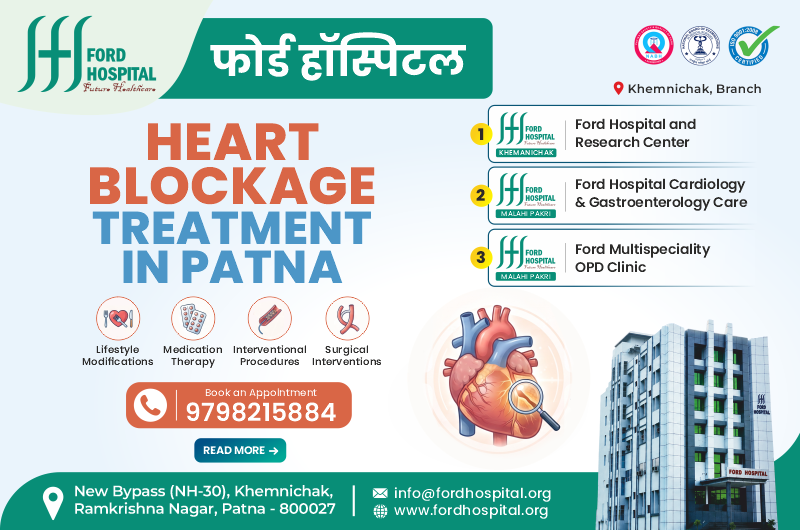
Managing heart blockages safely requires matching the complexity of the patient’s blockage to the right clinical infrastructure. Within the Ford Hospital network, care is organized sequentially across three specialized facilities in Patna: led by our flagship 24×7 surgical and emergency hospital, supported by our dedicated interventional cardiology and gastroenterology institute, and connected to our streamlined outpatient diagnostic clinic.
Located near New Bypass, Khemnichak, Patna, Ford Hospital & Research Center serves as our primary 105-bedded multispeciality inpatient, emergency, and cardiothoracic surgical campus. When a patient presents with a 100% acute coronary occlusion (heart attack), complex triple-vessel disease, calcified left main blockages, or multi-organ complications, this flagship facility provides complete interventional, surgical, and intensive care support under one roof.
During an acute heart attack, every minute of blocked blood flow destroys heart muscle fibers. The hospital’s emergency department operates 24×7 Golden Hour protocols backed by Advanced Life Support (ALS) ambulances, point-of-care High-Sensitivity Troponin assays, and direct transfer to the on-site flat-panel Digital Catheterization Laboratory (Cath Lab) for emergency Primary Angioplasty (Primary PCI).
For patients whose coronary angiogram reveals diffuse multi-vessel blockages unsuitable for stenting—especially those with long-standing diabetes or accompanying heart valve defects—our modular Cardiothoracic & Vascular Surgery (CTVS) theaters perform Beating-Heart (Off-Pump) CABG, conventional bypass surgery using arterial grafts (such as the Left Internal Mammary Artery – LIMA), and surgical valve repair or replacement. High-risk patients recovering from cardiogenic shock or open-heart surgery are stabilized in dedicated Intensive Coronary Care Units (ICCU) equipped with Intra-Aortic Balloon Pumps (IABP), mechanical ventilators, temporary and permanent pacemakers, and 24×7 bedside dialysis backup.
Because patients with severe heart blockages frequently suffer from co-existing kidney impairment, diabetes, respiratory disease, or neurological stroke risks, the main campus integrates 20 specialized inpatient and surgical departments:
Located at Malahi Pakri, Kankarbagh, Patna, Ford Hospital Cardiology & Gastroenterology Care functions as our specialized dual-specialty institute focused on high-precision catheter revascularization, electrical conduction block treatment, and the clinical overlap between heart blockages and gastrointestinal disorders.
Interventional cardiologists at this center utilize a “Radial-First” approach—performing diagnostic coronary angiographies and stenting through the radial artery in the wrist rather than the femoral artery in the groin. This technique reduces local bleeding risks, improves patient comfort, and allows earlier walking after the procedure. To treat calcified, tortuous, or bifurcated coronary blockages accurately, the Cath Lab integrates three advanced intravascular technologies:
Furthermore, patients who receive coronary stents must take Dual Antiplatelet Therapy (DAPT—such as Aspirin plus Clopidogrel, Prasugrel, or Ticagrelor) for several months to keep the stent open. In patients with pre-existing acid peptic disease or H. pylori gastritis, blood thinners can trigger stomach ulcers or upper gastrointestinal bleeding. Having senior cardiologists and gastroenterologists collaborating daily under one roof ensures immediate endoscopic protection and safe medication adjustment without compromising heart stent safety.
Explore Our Dedicated Core Services:
For patients experiencing mild exertional chest heaviness, borderline ECG changes, or risk factors like diabetes, high cholesterol, and hypertension—as well as patients needing scheduled follow-ups after angioplasty or bypass surgery—the Ford Multispeciality OPD Clinic provides a calm, crowd-free outpatient environment. Currently dedicated to specialized OPD services across Cardiology, Gastroenterology, Gynecology, Psychiatry, General & Laparoscopic Surgery, Internal Medicine, and Diabetes/Endocrinology, the clinic focuses on non-invasive blockage detection and long-term plaque stabilization.
Cardiologists at the OPD clinic perform foundational non-invasive tests—including resting 12-lead ECGs, 2D Color Doppler Echocardiography (to check for regional wall motion abnormalities caused by blocked arteries), and Treadmill Stress Testing (TMT) to detect exercise-induced ischemia. When blockages are mild or stable, clinicians initiate Guideline-Directed Medical Therapy (GDMT) to halt plaque progression, alongside dietary lipid counseling, glycemic control, and structured cardiac rehabilitation.
Outpatient Specialty Directory at Ford Multispeciality OPD Clinic:
To help patients and family members select the appropriate Ford Hospital branch based on symptom urgency and required intervention, review the comparison table below:
| Clinical Parameter | #1 Ford Hospital & Research Center | #2 Ford Cardiology & Gastro Care | #3 Ford Multispeciality OPD Clinic |
| Facility Role | 24×7 Emergency, ICCU & CTVS Bypass Hospital | Interventional Cardiology & Gastro Institute | Dedicated Daytime Outpatient (OPD) Clinic |
| Location | New Bypass, Khemnichak, Patna | Malahi Pakri, Kankarbagh, Patna | Patna Outpatient Center |
| Target Blockage | Acute heart attack, Triple-Vessel & Left Main | Single/Double vessel & Electrical Heart Block | Mild plaque (under 50%) & Stable Angina |
| Key Diagnostics | 24×7 ECG/Troponin, Digital Cath Lab & CT | Radial Cath Lab, FFR, IVUS, OCT & Endoscopy | 12-Lead ECG, 2D Echo, TMT & Lipid Panels |
| Core Treatments | Primary PCI, Beating-Heart CABG & Valve Surgery | Complex Stenting, Pacemaker, AICD & CRT-D | Medical Therapy (GDMT), Diet & Cardiac Rehab |
How to Use This Table:
Safe management of coronary and electrical heart blockages relies on collaboration within a multidisciplinary Heart Team—combining non-invasive diagnosticians, interventional cardiologists, and cardiothoracic surgeons. In compliance with NMC guidelines regarding transparent presentation of medical qualifications, below is our specialist directory with direct consultation links:
1. Can a 70% to 90% coronary artery blockage be dissolved with tablets or injections without angioplasty?
If a blockage is caused by a fresh blood clot during the first few hours of an acute heart attack, clot-busting injections (thrombolysis) can partially dissolve the fresh clot—though emergency Primary Angioplasty remains the gold-standard treatment. However, chronic stable blockages (70% to 90%) are composed of hardened fibrous plaque, cholesterol crystals, and calcium built up over years. While medications (statins and antiplatelets) are essential to stabilize this plaque and prevent new clots, they cannot dissolve hardened fibrotic calcium; severe flow-limiting narrowings require mechanical opening via angioplasty stenting or bypass surgery.
2. How does the Heart Team decide between Angioplasty (Stenting) and CABG (Bypass Surgery)?
The decision is based on the SYNTAX score (anatomical complexity of the blockages), the number of vessels involved, Left Ventricular Ejection Fraction (LVEF), and whether the patient has diabetes. Focal blockages in one or two coronary arteries are generally treated with minimally invasive Drug-Eluting Stents (PCI). Conversely, diffuse blockages across all three coronary arteries (Triple-Vessel Disease) or severe narrowing of the Left Main stem—particularly in diabetic patients—often achieve better long-term survival and lower repeat-procedure rates with CABG Bypass Surgery.
3. What is “Beating-Heart” (Off-Pump) Bypass Surgery, and how does it help recovery?
In traditional bypass surgery, the heart is temporarily stopped and circulation is maintained by a heart-lung bypass machine. In Beating-Heart (Off-Pump) CABG, performed by our CTVS team at Ford Hospital & Research Center, specialized tissue stabilizers hold only the tiny section of the heart artery being grafted while the rest of the heart continues beating naturally. This technique reduces systemic inflammation, lowers the risk of post-operative kidney or neurological strain in elderly and diabetic patients, and supports smoother ICU recovery.
4. How long does a modern Drug-Eluting Stent (DES) last after heart blockage treatment?
Modern third-generation Drug-Eluting Stents are permanent metallic scaffolds coated with a slow-release antiproliferative medication that prevents scar tissue from growing inside the stent. When deployed using intravascular imaging (IVUS or OCT) to ensure full expansion—and when the patient strictly takes prescribed Dual Antiplatelet blood thinners, controls blood sugar/cholesterol, and avoids tobacco—a stent is designed to remain open for life.
5. Is cashless hospitalization available for coronary angiography, stenting, pacemakers, and bypass surgery?
Yes. Both Ford Hospital & Research Center and Ford Hospital Cardiology & Gastroenterology Care operate dedicated Third-Party Administrator (TPA) and insurance coordination desks. We facilitate cashless hospitalization and treatment approvals for diagnostic angiography, IVUS/OCT-guided angioplasty, pacemaker/AICD implantation, and CABG bypass surgery under major private health insurance providers and eligible government healthcare schemes, subject to policy terms and verification.