
Emergency : +91 9798215884   |   Front Desk : +91 93863 92846   |   Address : New Bypass (NH-30), Khemnichak, Patna - 800027 (Bihar)

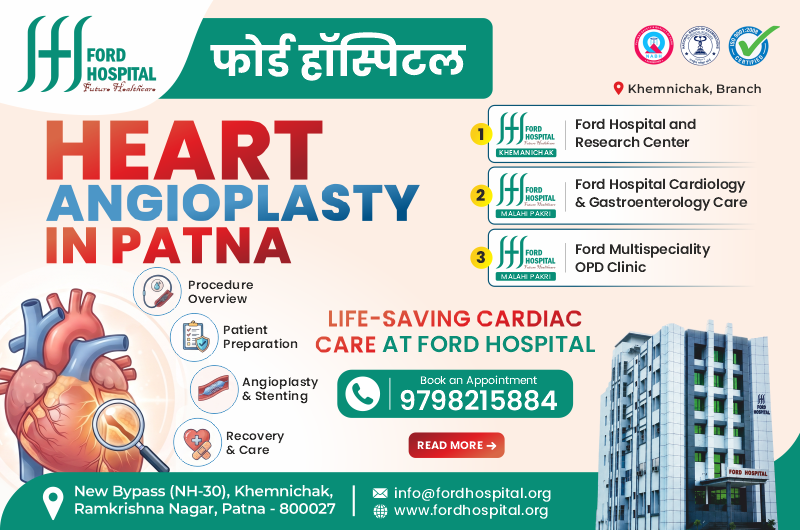
Heart Angioplasty in Patna

Heart Angioplasty in Patna

Heart Angioplasty in Patna: A Clinical Guide to Percutaneous Coronary Intervention, Stent Technology, and Post-Procedure Recovery

Heart angioplasty—known clinically as Percutaneous Coronary Intervention (PCI)—is a minimally invasive, catheter-based procedure used to open narrowed or obstructed coronary arteries and restore oxygenated blood flow to the heart muscle without open-chest surgery. During the procedure, an interventional cardiologist threads a thin, flexible catheter through a small arterial puncture in the wrist or groin up to the heart, inflates a miniature medical balloon to compress cholesterol plaque against the vessel wall, and deploys a metallic mesh tube called a Drug-Eluting Stent (DES) to keep the artery open permanently.

In Patna and across Bihar, rising rates of Type 2 diabetes, hypertension, dyslipidemia, and tobacco use have led to an increased clinical demand for both emergency life-saving angioplasty during acute heart attacks and planned angioplasty for chronic exertional chest pain. Understanding when a coronary stent is clinically necessary, how modern intravascular imaging improves procedural safety, and how post-stent medications are managed helps patients and families navigate treatment with clarity.

In strict adherence to the National Medical Commission (NMC) guidelines for factual, transparent, and non-promotional medical education, this guide explains the clinical indications for coronary angioplasty, the step-by-step procedural workflow, and how the Ford Hospital network coordinates interventional, surgical, and outpatient cardiac care across three specialized facilities in Patna.

Clinical Indications: When Is a Heart Angioplasty Medically Required?

Not every patient diagnosed with coronary plaque requires a stent. In evidence-based cardiology, percutaneous coronary intervention is recommended only when specific anatomical and physiological criteria are met. Clinicians classify heart angioplasty into two primary categories based on urgency and symptom presentation:

  • Emergency Primary Angioplasty (Primary PCI for Acute Heart Attacks): When an atherosclerotic plaque ruptures suddenly inside a coronary artery, a blood clot forms within minutes and completely blocks blood flow, triggering an ST-Elevation Myocardial Infarction (STEMI) or high-risk Non-STEMI. Performing an emergency angioplasty within the critical Golden Hour (targeting a door-to-balloon time of less than 90 minutes) mechanically clears the clot, deploys a stent, and prevents irreversible death of the heart muscle.
  • Elective Angioplasty for Refractory Stable Angina: When a patient experiences predictable chest heaviness, squeezing, or breathlessness during physical exertion despite taking optimal anti-anginal medications, and diagnostic testing confirms a coronary stenosis of 70% or greater in one or two major vessels.
  • Physiology-Guided Angioplasty for Intermediate Blockages (50% to 69%): When a coronary angiogram reveals a borderline narrowing between 50% and 69%, visual estimation alone cannot confirm whether the blockage is starving the heart muscle of oxygen. Cardiologists pass a pressure-sensing wire to measure Fractional Flow Reserve (FFR); an FFR score of 0.80 or less confirms functional ischemia and indicates that stenting will benefit the patient.
  • Unstable Angina & Silent Myocardial Ischemia: Chest discomfort that occurs unexpectedly at rest or increases rapidly in severity, or painless ischemia detected on a Treadmill Stress Test (TMT) in patients with long-standing diabetes.
  • High-Risk Left Main or Complex Anatomy (When Surgery Is Contraindicated): Selected patients with narrowing of 50% or greater in the Left Main coronary artery or complex bifurcations who are evaluated jointly by the Heart Team and guided by intravascular ultrasound.

Inside the Cath Lab: How Modern Angioplasty & Stenting Works Step-by-Step

Patients often feel anxious before an angioplasty because they imagine a major surgical operation. In reality, coronary angioplasty is performed under local anesthesia while the patient remains awake and comfortable inside a specialized Digital Catheterization Laboratory (Cath Lab):

  1. Step 1 – “Radial-First” Wrist Access vs. Femoral Access: Modern clinical guidelines recommend the transradial approach (accessing the radial artery in the wrist) as the preferred route over the traditional femoral artery in the groin. Wrist access significantly lowers the risk of local bleeding, eliminates the need to lie flat in bed for 8 hours post-procedure, and allows stable patients to sit up and walk much earlier.
  2. Step 2 – Coronary Angiography & Intravascular Mapping: A thin hollow tube (guiding catheter) is advanced to the opening of the coronary arteries, and a small amount of radiopaque contrast dye is injected under real-time X-ray fluoroscopy to map the exact location and length of the blockage.
  3. Step 3 – Microscopic Imaging (IVUS & OCT): For complex, calcified, or long blockages, interventional cardiologists insert miniature imaging catheters—Intravascular Ultrasound (IVUS) or Optical Coherence Tomography (OCT). OCT provides 10-fold higher spatial resolution than ultrasound to inspect plaque rupture and calcium thickness, while IVUS measures the true vessel diameter from wall to wall so the cardiologist can select the exact stent size.
  4. Step 4 – Balloon Predilatation & Drug-Eluting Stent Deployment: A hair-thin flexible guidewire is navigated across the blockage. A small balloon catheter is inflated for a few seconds to compress the plaque and widen the channel. Next, a third-generation Drug-Eluting Stent (DES)—crimped onto a second balloon—is positioned across the lesion and expanded into the arterial wall. The balloon is deflated and removed, while the stent remains permanently in place, slowly releasing anti-proliferative medication over several months to prevent scar tissue from re-narrowing the vessel (in-stent restenosis).
  5. Step 5 – Post-Dilatation & Final Imaging Check: High-pressure non-compliant balloons and repeat IVUS/OCT scans verify that the stent struts are completely flush against the vessel wall (optimal stent apposition), ensuring smooth blood flow before the wrist sheath is removed and a gentle compression band is applied.

Integrated Facilities for Heart Angioplasty Across the Ford Hospital Network

Successfully treating a coronary blockage requires more than just placing a stent; it requires 24×7 cardiothoracic surgical backup for complex emergencies, precision catheter imaging, management of blood-thinner side effects, and structured outpatient follow-up. Within the Ford Hospital network, care is organized sequentially across three specialized facilities in Patna:

1 Ford Hospital & Research Center — Flagship 24×7 Emergency Primary Angioplasty, Tertiary ICCU & CTVS Surgical Backup Campus

Located near New Bypass (NH-30), Khemnichak, Patna, Ford Hospital & Research Center serves as our primary 105-bedded multispeciality inpatient, emergency, and surgical campus. When a patient arrives in the middle of an acute heart attack, cardiogenic shock, or requires high-risk multi-vessel angioplasty with immediate surgical and multi-organ intensive care backup, this flagship campus provides end-to-end tertiary infrastructure under one roof.

  • 24×7 Golden Hour Primary PCI & Flat-Panel Digital Cath Lab: The emergency department operates round-the-clock door-to-balloon protocols supported by Advanced Life Support (ALS) cardiac ambulances, immediate 12-lead ECG triage, and point-of-care High-Sensitivity Troponin testing. The on-site flat-panel Digital Cath Lab enables immediate emergency Primary Angioplasty to open occluded arteries at any hour of the day or night.
  • On-Site Cardiothoracic & Vascular Surgery (CTVS) Standby: During complex angiographies, approximately 15% to 20% of patients are found to have diffuse triple-vessel blockages, severe calcified left main disease, or accompanying heart valve defects where open-heart bypass surgery is safer and more durable than stenting. Having modular CTVS operating theaters on the same campus allows the Heart Team to perform Beating-Heart (Off-Pump) CABG or emergency surgical bailout without transferring the patient to another hospital.
  • Intensive Coronary Care Unit (ICCU) & Cardiorenal Protection: High-risk angioplasty patients—such as those with low Left Ventricular Ejection Fraction (LVEF less than 35%), acute pulmonary edema, or chronic kidney disease—are monitored in specialized ICCUs equipped with Intra-Aortic Balloon Pumps (IABP), mechanical ventilators, temporary pacemakers, and Contrast-Induced Nephropathy (CIN) prevention protocols backed by 24×7 bedside dialysis.

To protect high-risk angioplasty inpatients who also have diabetes, renal impairment, stroke risks, or surgical emergencies, the main campus integrates 20 specialized inpatient and surgical departments:

2 Ford Hospital Cardiology & Gastroenterology Care — Dedicated Center for Radial-First, Image-Guided Stenting & Antiplatelet GI Protection

Located centrally at Malahi Pakri, Kankarbagh, Patna, Ford Hospital Cardiology & Gastroenterology Care functions as our specialized dual-specialty institute built for high-precision catheter interventions and the clinical co-management of cardiovascular and digestive health.

  • Precision-Guided Stenting (FFR, IVUS & OCT): Interventional cardiologists at this facility utilize a “Radial-First” wrist-access approach combined with physiological and intracoronary imaging tools. Using FFR ensures stents are only placed in arteries that truly restrict blood flow, avoiding unnecessary stenting. Using IVUS and OCT allows millimetric sizing and expansion of Drug-Eluting Stents in complex bifurcations, calcified arteries, and chronic total occlusions.
  • Cardiac Rhythm & Device Support: When coronary ischemia triggers electrical conduction blocks or weakens the heart muscle, specialists perform implantations of Permanent Pacemakers, Implantable Cardioverter-Defibrillators (ICDs), and Cardiac Resynchronization Therapy (CRT) devices.
  • Safeguarding Post-Angioplasty Blood Thinners (The Cardio-Gastric Advantage): Every patient who undergoes coronary angioplasty must take Dual Antiplatelet Therapy (DAPT—typically Aspirin combined with Clopidogrel, Prasugrel, or Ticagrelor) for 6 to 12 months to prevent a lethal blood clot from forming inside the new metallic stent (stent thrombosis). However, these mandatory blood thinners can irritate the stomach lining and trigger upper gastrointestinal bleeding in patients with silent peptic ulcers or H. pylori gastritis. By housing senior cardiologists and gastroenterologists in the same building, high-risk patients receive preventive gastro-protective regimens, and if GI bleeding ever occurs, gastroenterologists perform immediate therapeutic endoscopy (such as endoscopic clipping) so the cardiologist does not have to dangerously stop the stent’s protective blood thinners.

Explore Our Dedicated Core Services:

  • Cardiology & Angioplasty Centre — Radial-First angiography, FFR/IVUS/OCT-guided Drug-Eluting Stent placement, pacemaker/ICD/CRT implantation, and 24×7 CCU monitoring.
  • Gastroenterology & Hepatology — Upper GI endoscopy, therapeutic hemostasis for antiplatelet-induced bleeding, FibroScan, and differential diagnosis of non-cardiac chest pain.

3 Ford Multispeciality OPD Clinic — Dedicated Outpatient Hub for Pre-Angioplasty Workup & Long-Term Stent Surveillance

Coronary angioplasty is not a standalone one-day cure; long-term stent patency depends on rigorous pre-procedural diagnosis and lifelong post-procedural risk factor control. The Ford Multispeciality OPD Clinic provides a calm, streamlined daytime outpatient environment dedicated to Cardiology, Gastroenterology, Gynecology, Psychiatry, General & Laparoscopic Surgery, Internal Medicine, and Diabetes/Endocrinology consultations.

  • Pre-Angioplasty Ischemia Screening: Patients with exertional chest tightness, diabetes, or high cholesterol undergo non-invasive outpatient testing—including resting 12-lead ECGs, 2D Color Doppler Echocardiography (to measure Ejection Fraction and detect regional wall motion abnormalities), and Treadmill Stress Testing (TMT)—to determine whether a diagnostic coronary angiogram is needed.
  • Post-Stent Follow-Up & DAPT Titration: Following discharge after an angioplasty at our inpatient hospitals, patients attend scheduled OPD visits at 1 week, 1 month, 3 months, and 6 months. Cardiologists monitor Dual Antiplatelet adherence, titrate high-intensity statins to keep LDL cholesterol below 55 mg/dL, control blood pressure and HbA1c, and supervise Phase-2 outpatient cardiac rehabilitation.

Outpatient Specialty Directory at Ford Multispeciality OPD Clinic:

Branch Comparison Table: Selecting the Right Facility for Your Angioplasty Journey

To help patients and family members choose the right branch at each stage of coronary angioplasty care, review the comparison table below:

Clinical Parameter#1 Ford Hospital & Research Center#2 Ford Cardiology & Gastro Care#3 Ford Multispeciality OPD Clinic
Primary Role24×7 Emergency PCI, ICCU & CTVS CampusPrecision Radial PCI & Cardio-Gastric HubPre-PCI Screening & Post-Stent OPD
LocationNew Bypass, Khemnichak, PatnaMalahi Pakri, Kankarbagh, PatnaPatna Outpatient Center
Ideal PatientAcute heart attack & high-risk multi-vesselRadial stenting, IVUS/OCT & GI bleed riskStable chest pain checkup & stent follow-up
Cath Lab & Tools24×7 Digital Cath Lab, IABP & CTVS OTsRadial Cath Lab, FFR, IVUS, OCT & Endoscopy12-Lead ECG, 2D Echo, TMT & Lipid Labs
Backup Support20 Departments, CTVS Bypass & ICU Dialysis24×7 CCU, Pacemakers & Therapeutic GI CareDaytime OPD across 7 Core Specialties

How to Navigate Our 3 Cardiovascular Branches:

  • Choose #1 Ford Hospital & Research Center (Khemnichak) immediately for 24×7 Emergency Primary Angioplasty during an acute heart attack, for high-risk angioplasty in patients with kidney failure or low pumping function needing ICU/dialysis backup, or when on-site CTVS Bypass Surgery (CABG) standby is required.
  • Choose #2 Ford Hospital Cardiology & Gastroenterology Care (Kankarbagh) for Radial-First wrist-access angiography, FFR/IVUS/OCT image-guided stenting, pacemaker/ICD implantation, or when an angioplasty patient has stomach ulcers, severe acidity, or bleeding risks from blood thinners.
  • Choose #3 Ford Multispeciality OPD Clinic for initial non-invasive blockage screening (ECG, 2D Echo, TMT) before deciding on an angiogram, and for all scheduled post-angioplasty OPD reviews, blood-thinner monitoring, diabetes control, and dietary rehab.

Clinical Directory: Our Interventional Cardiologists & CTVS Surgical Team

Successful coronary angioplasty relies on the skill of the interventional cardiologist operating the catheter and the collaborative backup of clinical cardiologists and cardiothoracic surgeons. In strict compliance with NMC ethical regulations regarding transparent presentation of medical qualifications, below is our cardiac specialist directory with direct consultation links:

  • Dr. B. B. Bharti (MBBS, MD, DM – Interventional Cardiology): Serving as Director of Cardiology with over 22 years of clinical experience in diagnostic coronary angiography, complex multi-vessel angioplasties, emergency Primary PCI, and cardiac device implantations.
  • Dr. Manmohan (MBBS, MS, MCh – Cardiothoracic & Vascular Surgery – CTVS): Lead CTVS Surgeon with over 34 years of surgical experience providing surgical Heart Team backup, Beating-Heart (Off-Pump) CABG bypass surgery, and complex heart valve replacements.
  • Dr. Sushant Kumar Pathak (MBBS, MD, DM – Interventional Cardiology): Consultant Interventional Cardiologist focusing on Golden Hour Primary PCI during acute myocardial infarctions and Optical Coherence Tomography (OCT) / IVUS-guided stent deployment for long-term stent durability.
  • Dr. Saroj Kr. Mishra (MBBS, MD, DM – Non-Invasive & Clinical Cardiology): Consultant Interventional Cardiologist specializing in the “Radial-First” wrist-access approach, physiology-guided stenting (FFR and IVUS), 2D Echocardiography, and pre/post-angioplasty evaluation.
  • Dr. Jyoti Kumari (MBBS, MD – Internal Medicine, DrNB – Cardiology): Consultant Cardiologist dedicated to outpatient cardiac triage, pre-angioplasty stress testing, hypertension and lipid optimization, and post-stent medical follow-up.
  • Dr. Vikash Kumar (MBBS, MD – Internal Medicine, DrNB – Cardiology): Consultant Cardiologist focusing on diagnostic evaluation of ischemic chest pain, antiplatelet and statin titration, and secondary cardiovascular prevention.
  • Dr. Shashank (MBBS, MD, DM – Clinical Cardiology & Heart Failure): Consultant Cardiologist specializing in post-angioplasty ventricular recovery, Guideline-Directed Medical Therapy (GDMT) for ischemic heart failure, and arrhythmia management.

Life After Heart Angioplasty: The 4-Pillar Stent Protection Protocol

Placing a Drug-Eluting Stent fixes the mechanical pinch in the treated segment, but preventing new blockages or clots requires strict adherence to a four-pillar medical protocol after hospital discharge:

  1. Never Skip Dual Antiplatelet Therapy (DAPT): Your prescribed blood thinners (Aspirin plus Clopidogrel, Prasugrel, or Ticagrelor) prevent platelets from sticking to the metallic stent struts before your natural endothelial cells grow over them. Stopping DAPT prematurely—even for a few days without consulting your cardiologist—carries a high risk of sudden acute stent thrombosis.
  2. Hit Aggressive LDL Cholesterol & HbA1c Targets: For patients who have undergone coronary angioplasty, international cardiology guidelines recommend lowering LDL (“bad”) cholesterol to less than 55 mg/dL using high-intensity statins (and ezetimibe when needed), while keeping blood pressure below 130/80 mmHg and diabetic HbA1c below 7.0%.
  3. Follow Radial Wrist-Site & Physical Activity Guidelines: After a transradial wrist angioplasty, avoid lifting heavy objects (greater than 3 to 5 kg) or straining the treated wrist for the first 5 to 7 days. Most stable elective angioplasty patients can resume light walking within 48 hours and return to desk work within a week, guided by their OPD cardiologist.
  4. Complete Tobacco Cessation & Cardioprotective Diet: Smoking after stent placement constricts coronary vessels and doubles the rate of stent re-narrowing. Pair complete tobacco avoidance with a low-sodium, high-fiber diet rich in vegetables, whole grains, and lean proteins monitored at our OPD nutrition clinic.

Frequently Asked Questions (FAQs)

1. What is the difference between Coronary Angiography and Coronary Angioplasty?

Coronary Angiography is a diagnostic test (taking 15 to 20 minutes) where contrast dye is injected via a thin wrist catheter to take X-ray movies of your heart arteries and see if any blockages exist. Coronary Angioplasty (PCI) is the therapeutic treatment (taking 45 to 90 minutes) where a balloon and a Drug-Eluting Stent are used to physically open a blocked artery. If a critical blockage is found during angiography, angioplasty can often be performed in the same sitting (Ad-Hoc PCI) after discussing findings with the family.

2. Is heart angioplasty painful, and does it require general anesthesia?

No. Heart angioplasty does not involve cutting open the chest and does not require general anesthesia in routine cases. The cardiologist numbs a small spot on your wrist (or groin) with a local anesthetic injection; you remain awake and alert throughout the procedure. Because the inside of coronary arteries lacks pain nerve endings, you do not feel the catheter moving—only a brief, mild warm flush when contrast dye is injected or a fleeting sensation of chest pressure for a few seconds when the balloon is inflated.

3. How do FFR, IVUS, and OCT help avoid unnecessary stents and prevent repeat blockages?

A standard X-ray angiogram shows only a flat two-dimensional silhouette of the artery. FFR (Fractional Flow Reserve) measures actual blood flow pressure across a 50% to 70% blockage; if the FFR score is above 0.80, the patient can be treated safely with medicines alone without needing a stent. When a stent is needed, IVUS (Intravascular Ultrasound) and OCT (Optical Coherence Tomography) scan the inside of the artery from within, ensuring the stent is sized accurately and expanded tightly against the vessel wall—which dramatically lowers the risk of future re-narrowing.

4. How long is the hospital stay after an elective vs. emergency heart angioplasty?

For a planned, uncomplicated elective transradial angioplasty, most patients can sit up within a few hours, walk the same evening, and are discharged home within 24 to 48 hours. For an emergency Primary Angioplasty performed during an acute heart attack, patients are monitored in the Intensive Coronary Care Unit (ICCU) for 3 to 5 days so cardiologists can track heart muscle recovery, stabilize heart rhythm, and titrate protective medications before discharge.

5. Is cashless hospitalization available for coronary angioplasty and stenting at Ford Hospital?

Yes. Both Ford Hospital & Research Center and Ford Hospital Cardiology & Gastroenterology Care operate dedicated 24×7 Third-Party Administrator (TPA) and insurance coordination desks. We facilitate cashless hospitalization and procedural approvals for diagnostic angiography, emergency Primary PCI, and IVUS/OCT-guided Drug-Eluting Stent placements under major public and private health insurance providers as well as eligible government healthcare schemes, subject to policy terms and verification.

SHARE THIS ARTICLE

Leave a Reply

Your email address will not be published. Required fields are marked *

Recent Comments

No comments to show.